The blips before the fall: why we started EarlySight
In business data, decline rarely comes out of nowhere. We wanted to know whether the same was true of pupils.
Before EarlySight, our work was analysing the financial data of small and medium-sized businesses.
One pattern kept coming up. When a business went into decline, it rarely came out of nowhere. There were blips first: small changes that looked like noise at the time. A bad month, then a normal one. Something slightly off, then back to how it was….and then disaster. We realised that the “normal” month after the blip was the SME papering over the cracks in a last-ditch effort to save itself.
On their own, none of them looked serious. Together, they told the story well before the results did. The decline was, for the most part, predictable. Not because anyone had a crystal ball, but because the early signs were already sitting in the data.
The same question, asked about pupils
When we started EarlySight, we asked the same question of pupil data. When a pupil’s attendance, behaviour or grades fall away, is it really sudden? Or are there blips first?
Our theory was simple. Poor attendance, poor behaviour and poor performance are very rarely things that couldn’t have been seen in the data beforehand.
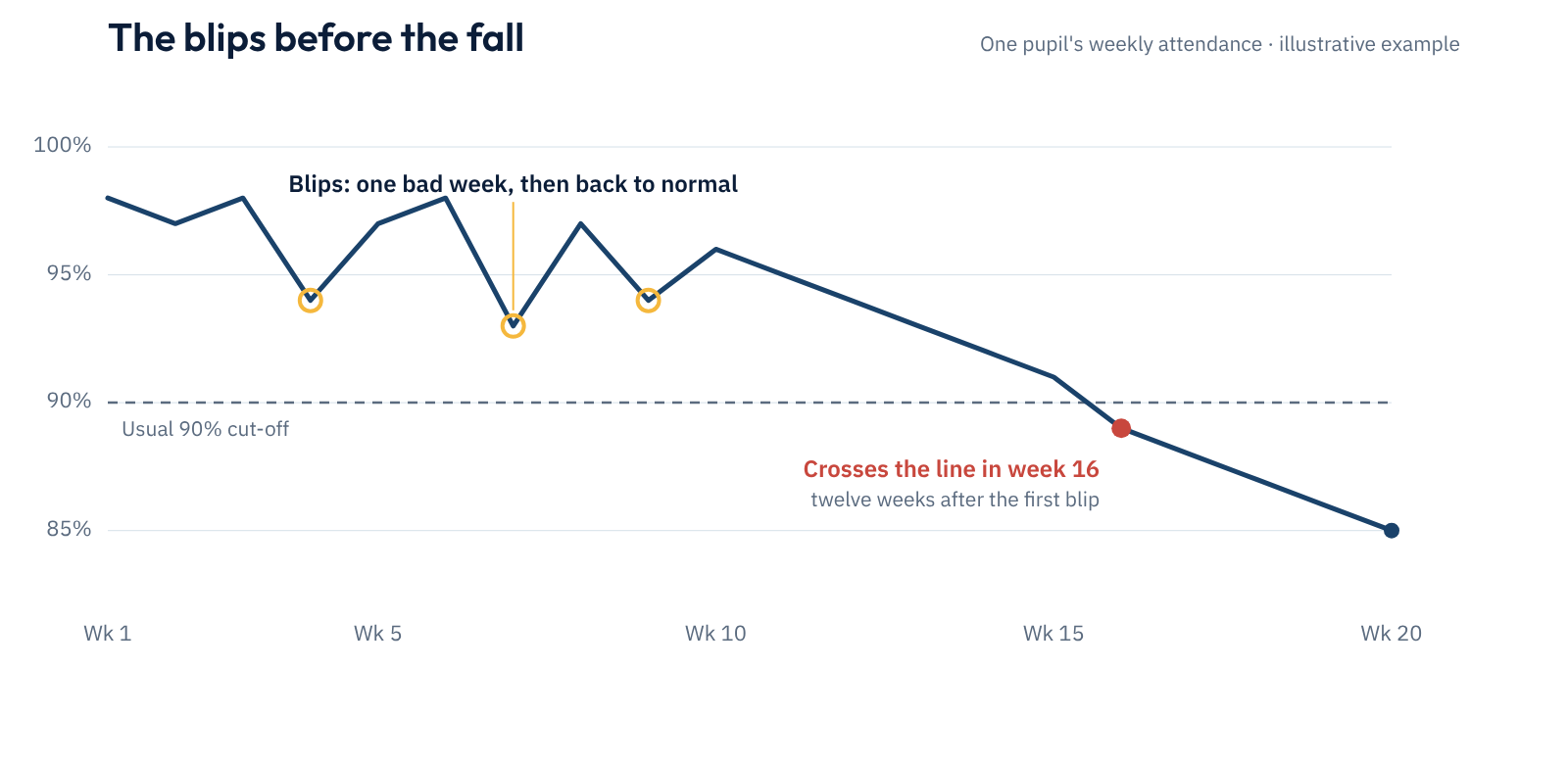
A pupil doesn’t usually go from fine to persistently absent overnight. First come the blips: a week with two days off, then a normal week. A lesson missed here and there. A first sanction for a pupil who has never had one. Effort slipping in one subject before it slips in the rest. The cover image is a real pupil’s data - our system would have alerted form tutors and year leaders 12 weeks before the pupil crossed the 90% threshold. As it was, the school didn’t act. EarlySight would have given them the ability to do so.
Each blip on its own is easy to miss. Schools are busy, and a single number on a report smooths them away. By the time the pupil crosses a threshold, the pattern has often been there for weeks.
Spot the change, not just the number
That’s the idea EarlySight is built on. Most reports tell you where a pupil is. We wanted to show which way they’re moving, and to compare each pupil with their own record, not only with a cut-off.
The blips are the opportunity. Seen early, they lead to a conversation. Seen late, they lead to an intervention.