Marked present. Missing English.
A pupil can be at every register and still skip lessons twice a week. The attendance figure won't show it. Here's how to find them in your own data.
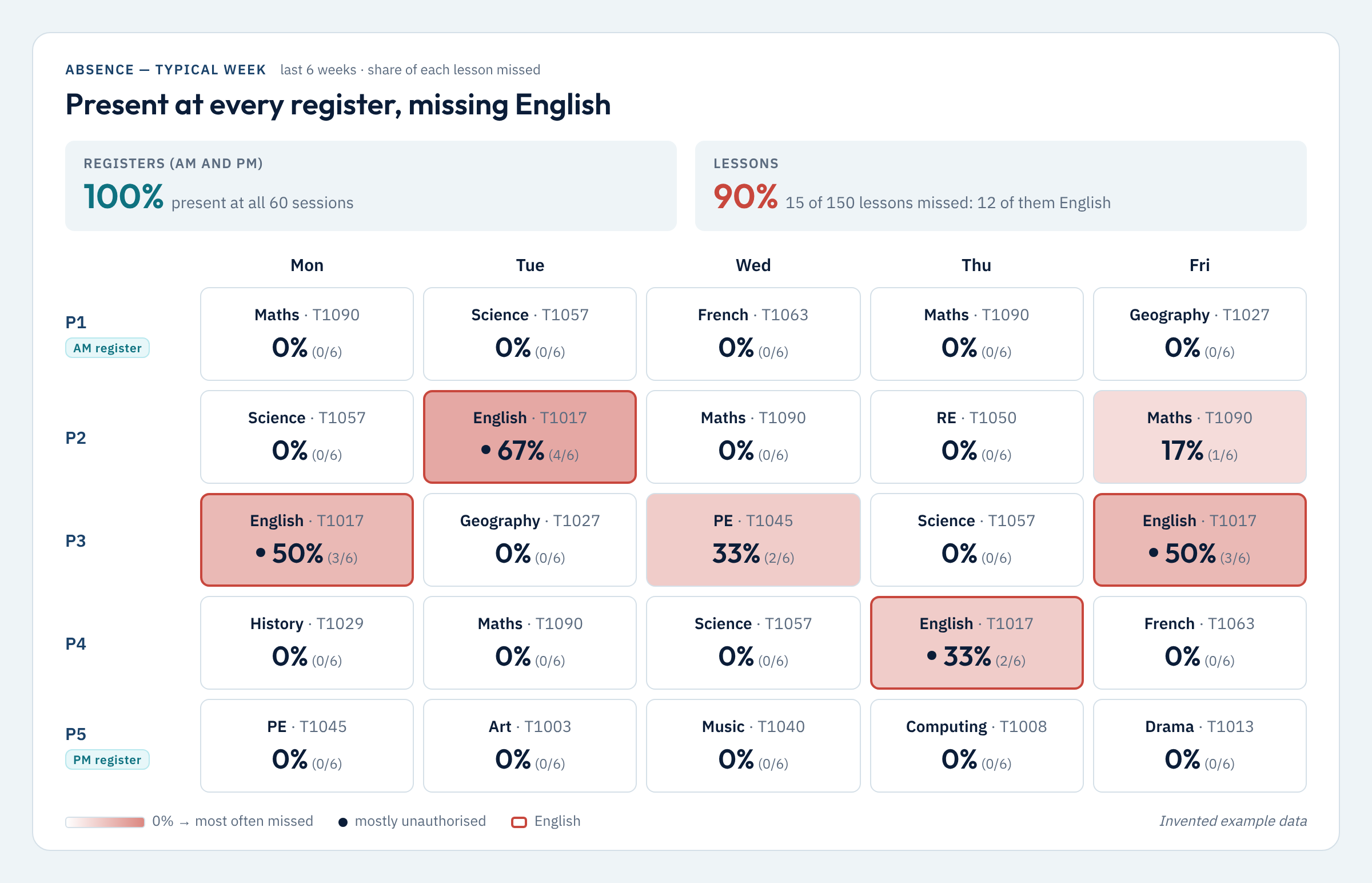
Meet a pupil your attendance report says is perfect. Present at every morning and afternoon register for six weeks: 100%.
They also missed 15 lessons in that time. Twelve of them were English.
Registers are taken at the start of the morning and the start of the afternoon. Whatever happens between those two marks never reaches the attendance figure. A pupil who is in at 8:40 and in at 1:30 can quietly miss the lessons in between, and still look like one of your best attenders.
How common is it?
More common than most of us would guess. The Key Group looked at 225 secondary schools on census day in October 2025. About 1 in 50 pupils who were present at both registers missed at least one lesson that day without authorisation.
It wasn’t spread evenly:
- pupils eligible for free school meals were nearly twice as likely to miss a lesson;
- pupils with SEND were more than twice as likely;
- pupils with both were more than three times as likely;
- it rose from about 1% of Year 7s to 3.3% of Year 11s.
That’s a single day. Across a half term, more pupils than that will have missed the odd lesson.
Why it matters
A missed lesson says something more specific than a missed day. It’s one subject, one teacher, often one time of the week. That points to a cause you can do something about: a lesson a pupil is struggling to follow, a group they want to avoid, a part of the day that goes wrong.
It’s also early. A pupil avoiding one subject is usually still coming in every day. That’s the moment for a conversation, before the avoidance spreads to whole days.
Find them in your own data on Monday
You don’t need anything new to start. Your lesson registers already hold the answer, even if your MIS needs a custom report to show it.
- Pick one year group and this half term.
- List the pupils at or near 100% attendance who have any unexplained lesson absences.
- For each one, look for repeats: the same subject, the same period, the same day.
- Talk to the subject teacher before the pupil. What happens in that lesson?
- Look again in two weeks. Is it the same lessons, or more of them?
The DfE’s statutory attendance guidance suggests that secondary schools look at lesson attendance within the school day for exactly this reason.
What we built
EarlySight reads lesson registers alongside the morning and afternoon registers, for every pupil. When a pupil misses one subject far more often than their other lessons, their form tutor and year leader see it on their list, with the missed lessons behind the flag. The school sets how many misses, and how much more often, before a pupil is flagged.
Sources: How big a problem is internal truancy?, Tes, 9 July 2026, reporting the Key Group’s analysis; Working together to improve school attendance, DfE.