What do form tutors need to see?
A form tutor has a few minutes and thirty pupils. They need a short list, a reason with every name, and the good news given the same space as the bad.
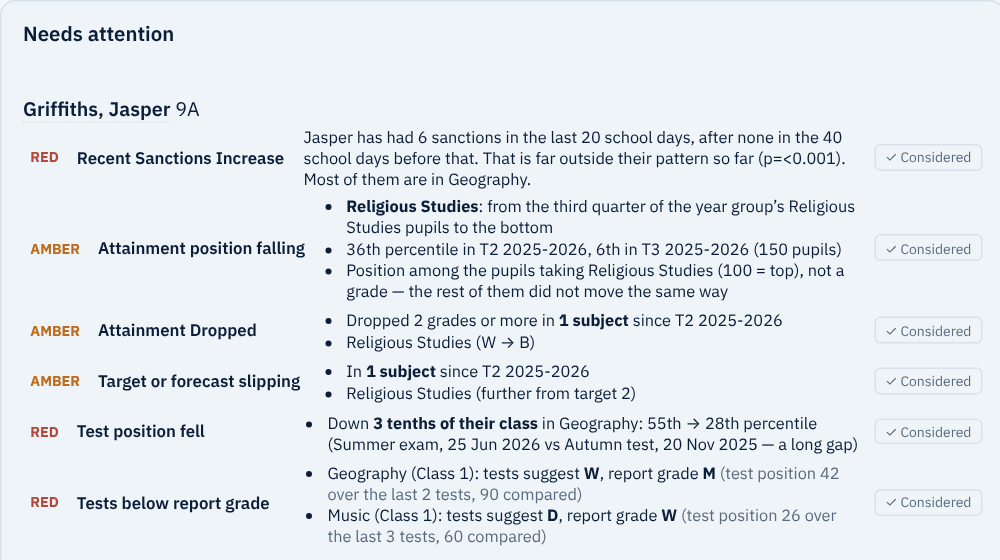
A form tutor sees their pupils every day, and knows them better than anyone. What they rarely have is time to go through the data on each of them, every week, looking for the ones who are starting to slip.
When we designed the Form Tutor page in EarlySight, we asked what a tutor needs in the few minutes they have. Here’s where we landed.
Their own pupils, and a short list
Not the whole school, not a spreadsheet. Just their form, with the pupils who need a look at the top. Each tutor sees their own form only, and the limits are enforced on the server, not just hidden on the screen.
A reason with every name
“Needs attention” means nothing without the why. So every flag comes with its evidence in plain words.
For example: “6 sanctions in the last 20 school days, after none in the 40 school days before that. Most of them in Geography.”
A tutor can read that, check it against what they know, and decide what to do. No codes to decode, no chart to interpret.
Compared with the pupil, not just a cut-off
Three sanctions in a fortnight means little for some pupils and a great deal for a pupil who has never had one. The quiet pupil with a new problem is the one a fixed threshold misses.
So EarlySight compares each pupil with their own record as well as with the school’s thresholds. Change is the signal.
Good news, given the same space
If the only list a tutor sees is problems, the data becomes something to dread. EarlySight shows “Going well” beside “Needs attention”, with the same number of pupils on each: grades rising, effort improving, tests above their report grade, house point milestones.
A tutor needs reasons to congratulate as much as reasons to worry. Pupils notice which one they hear.
A way to say “I’ve dealt with this”
When a tutor has had the conversation, they mark the concern as considered, with a short note. It leaves their list without being deleted, and the year leader can see it has been dealt with.
That’s a simple record of action, made as part of the job rather than on top of it.
Their form against the year
Tutors also want to know how their form is doing as a group. Five cards compare it with the other forms in the year: attendance, persistent absence, sanctions, house points, and house points per sanction.
Each figure is shown twice, as it is and with the extremes pulled in. When they disagree, it’s a few pupils, not the whole form, and that changes the conversation with the year leader.
What tutors don’t need
Whole-school statistics, grade tables for every subject, or a system to learn. If it takes training to read, it won’t be read in tutor time.