What it spots
Find the pupils who are in school but missing lessons
Your attendance figure counts the morning and afternoon registers. EarlySight reads your lesson registers too, and shows which pupils are missing lessons in between, which subjects, and when.
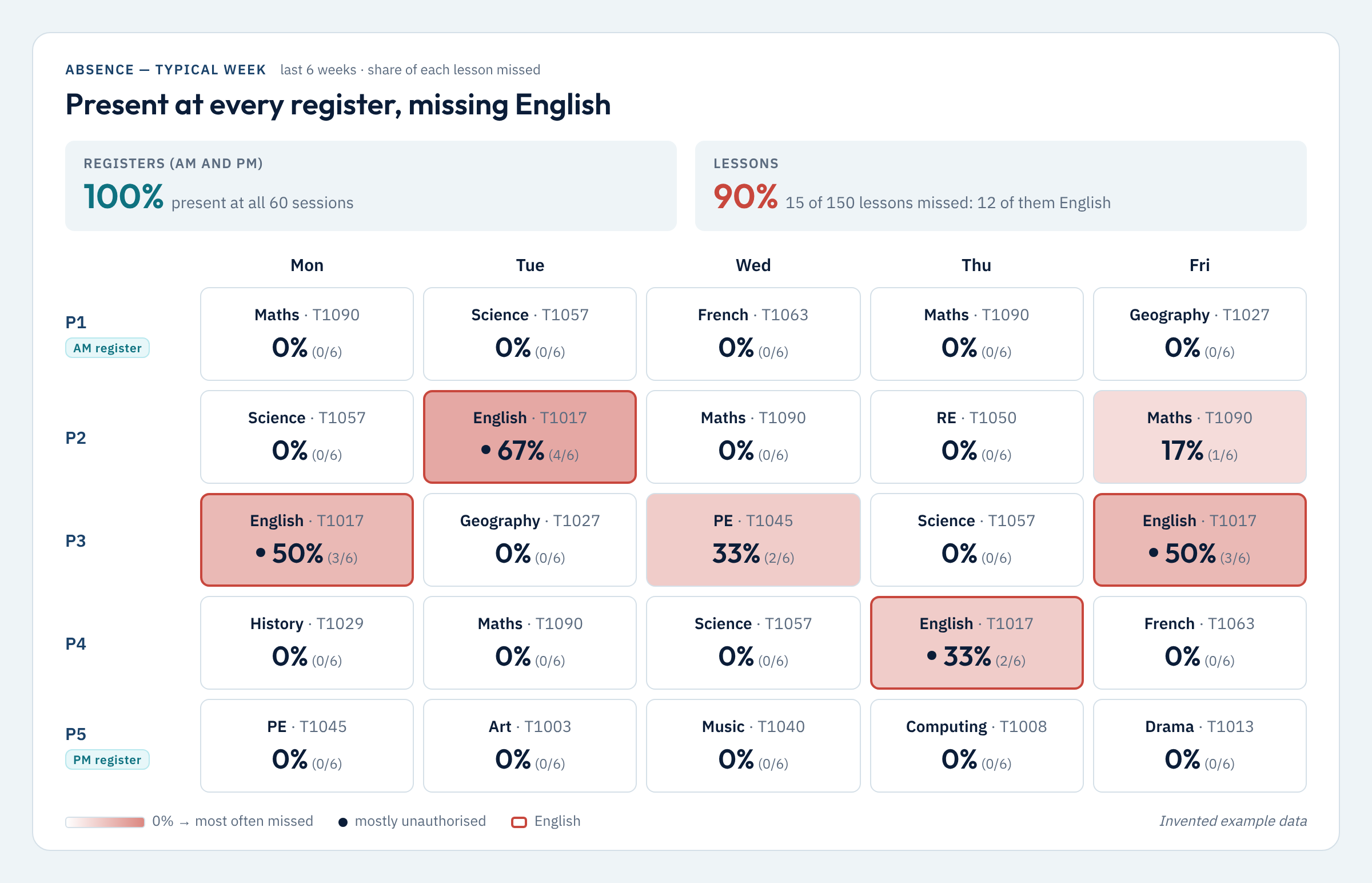
Statutory attendance counts sessions: one mark in the morning and one in the afternoon. Whatever happens between those two registers never reaches the figure. A pupil who is in at 8:40 and in at 1:30 can miss the lessons in between and still look like one of your best attenders.
That gap has a name in schools: internal truancy, or post-registration truancy. Your lesson registers already record it. What’s usually missing is the time to go through them pupil by pupil, every week.
How common is it?
More common than most of us would guess. The Key Group looked at 225 secondary schools on census day in October 2025. About 1 in 50 pupils who were present at both registers missed at least one lesson that day without authorisation.
It wasn’t spread evenly:
- pupils eligible for free school meals were nearly twice as likely to miss a lesson;
- pupils with SEND were more than twice as likely;
- pupils with both were more than three times as likely;
- it rose from about 1% of Year 7s to 3.3% of Year 11s.
That’s one day. Across a half term, more pupils than that will have missed the odd lesson.
What EarlySight shows
EarlySight reads your lesson registers alongside the morning and afternoon registers, for every pupil.
- Subject avoidance. When a pupil misses one subject far more often than their other lessons, they appear on their form tutor’s and year leader’s lists, with the missed lessons behind the flag.
- Patterns in the week. Repeated absences from the same lesson, such as Thursday period 1 English, are picked out, because a pattern points to a cause: one subject, one teacher, one time of the week.
- Each pupil’s typical week. A grid of the school week shows which lessons a pupil tends to miss, so a tutor can see the pattern at a glance before the conversation.
- Your school’s own rules. The school decides how many missed lessons, and how much more often than the pupil’s other lessons, before a pupil is flagged.
Every flag comes with its reason, and staff can mark a concern as considered once they’ve looked into it.
Why it matters
A missed lesson says something more specific than a missed day. It points to something you can act on: a lesson a pupil is struggling to follow, a group they want to avoid, a part of the day that goes wrong.
It’s also early. A pupil avoiding one subject is usually still coming in every day. That’s the moment for a conversation, before the avoidance spreads to whole days. The DfE’s guidance, ‘Working together to improve school attendance’, suggests that secondary schools look at lesson attendance within the school day for this reason.
What you need
- Lesson registers in your MIS. EarlySight uses the registers your staff already take. There’s nothing new to record.
- Works with all major MIS providers. EarlySight reads your MIS’s own exports or can integrate directly via Wonde (subject to MIS API availability).
- Your figures stay as they are. EarlySight only reads your data. It never writes anything back to your MIS, so your statutory attendance figures are unchanged.
Questions schools ask
Does this replace our statutory attendance figure?
No. Your statutory figure still comes from the morning and afternoon registers. EarlySight shows it too, with lesson attendance beside it.
Who sees which pupils?
Each member of staff sees the pupils in their remit: form tutors their form, year leaders their year, senior leaders the whole school.
Can we compare groups of pupils?
Yes. Attendance can be split by FSM and SEND, the same groupings the DfE uses, and by any groups your school sets up.
Read more: Marked present. Missing English. on our blog.
Sources: How big a problem is internal truancy?, Tes, 9 July 2026, reporting the Key Group’s analysis; Working together to improve school attendance, DfE.